I was proud to represent TWIST at this year’s International Coalition of Girls’ Schools Global Forum, where we were honored to both partner with and sponsor an organization dedicated to advancing girls’ education around the world.
The conference brought together school leaders, educators, advocates, and mission-aligned partners who share a belief in the power of girls’ schools. For me, it was also a chance to talk about something I think about often in our work with girls’ school branding:
How do you honor what people love while making your value easier for today’s families to understand?
That question was at the center of my session, Historically Modern. It is a simple idea, but not simple work. Every school has something it is afraid to change. A crest. A color. A motto. A building. A tradition. A story alumnae still tell.
And usually, that fear is not irrational. It comes from love.
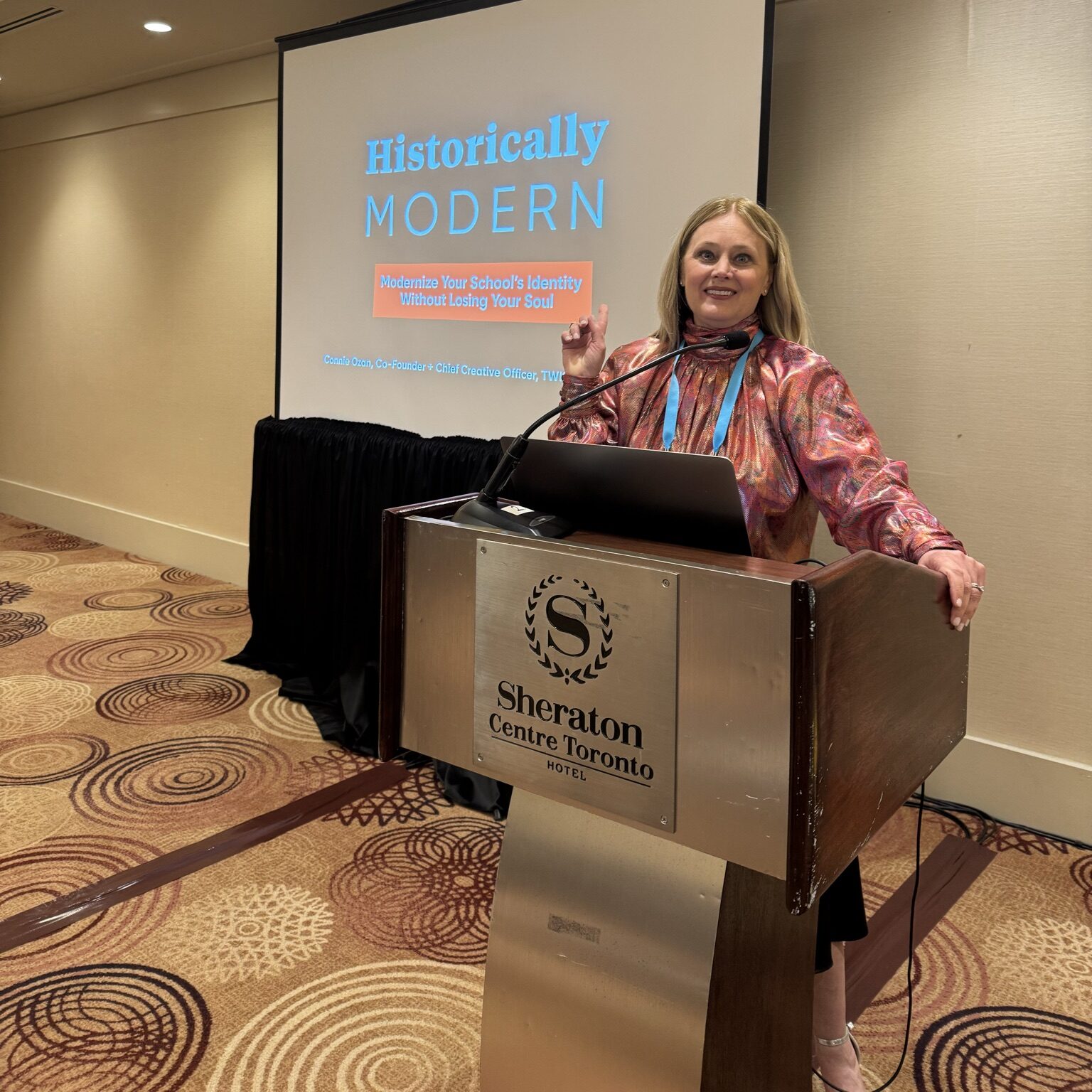
Schools Do Not Resist Change Because They Are Old-Fashioned
In schools, resistance often means something matters. The alumna who worries about a crest is not really worried about a crest. She is worried about recognition. Continuity. Whether the place she loved still remembers itself. The parent who questions a new message may not be resisting strategy. They may be asking whether the institution is still anchored in the values that made it worthy of their trust.
That is what makes school identity work different.
A school’s identity is not simply a logo, a palette, a viewbook, or a website. It is a container for memory, belonging, pride, and belief. It holds what generations of students, families, faculty, alumnae, and donors have invested in the institution. But without a willingness to evolve, that equity can stop growing. What once represented strength can slowly become a barrier to understanding.
The challenge is not choosing between preserving equity and moving forward. The challenge is making sure the equity a school has built continues to create value for the future.
The Question Is Not, ‘How Do We Look More Modern?’
This is where I often see modernization go wrong. A school decides the website feels dated. The logo feels old. Admissions materials feel quiet. The conversation quickly becomes cosmetic: How do we make this look newer? That is not the best question. The better question is: How do we make enduring value easier to understand? That is the real work. Not novelty. Not trend. Not redesign for its own sake. The work is translation.
Historically Modern is not nostalgia. Nostalgia says, ‘We remember.’ But nostalgia alone can turn a school into a museum of itself. Historically Modern is not reinvention either. Reinvention can look bold, but in schools it can create distrust if people no longer recognize what made the institution meaningful. Historically Modern is translation. It takes what has always been true and expresses it in a way today’s families, students, donors, and communities can understand.
Do Not Confuse the Container With the Truth
One of the most important things I believe about identity work is this: schools often confuse what is true with how that truth is expressed. Confidence. Leadership. Belonging. Faith. Access. Rigor. Service. Opportunity. These may be truths.
A crest, motto, color, campus, viewbook, website, campaign, or tradition may be expressions of those truths. That distinction matters. The crest is not the truth. It is one expression of the truth. The motto is not the truth. It is one expression of the truth. The building is not the truth. It is one expression of the truth. When a school understands the difference, change becomes less threatening. The conversation moves from ‘What are we allowed to change?’ to ‘What must remain meaningful?’
Not everything old is sacred. Not everything familiar is strategic. Not everything new is progress. The work is discernment. What carries meaning? What carries habit? What carries confusion? What carries opportunity?
Refresh, Update, or Complete Change?
When we work with schools, one of the first things we try to understand is the level of change actually required.
A refresh is right when the truth is still strong, but the expression is tired. The school knows who it is. The promise still holds. The community still recognizes the identity. But the system may feel dated, inconsistent, hard to use, or weak across digital, admissions, and advancement channels.
An update is needed when the school has evolved, but the identity has not kept up. New leadership. A new strategic plan. A new academic model. A new enrollment challenge. A new campus investment. A new competitive context. The institution has moved, but the identity is still telling an older version of the story.
A complete change is appropriate when the identity is carrying the wrong meaning. Maybe the school has merged. Maybe the mission has expanded. Maybe the current identity creates confusion. Maybe the brand is no longer aligned with the school’s future.
Age is not the problem. Loss of meaning is the problem.
An old identity is not automatically weak. A new identity is not automatically strong. The real questions are: Is it understood? Is it useful? Is it flexible? Is it credible? Does it help people believe?
Close the Meaning Gap
Schools often speak in institutional language. Tradition. Excellence. Community. Leadership.
Families are listening through much more personal questions.
Will my daughter belong? Will she be known? Will she be prepared? Will this be worth it?
That is the meaning gap. The job of brand is not to make a school sound different from itself. The job is to translate what the school believes into language and experiences that families can feel, understand, and act on.
For independent schools, reputation must become relevance.
For faith-based schools, belief must become invitation.
For public and mission-driven schools, access must become aspiration.
The context changes. The identity challenge is remarkably similar. How do we make the value easier to understand before a family has had the chance to experience it for themselves?
Keep. Translate. Activate.
For school leaders wondering where to begin, I would start with a simple framework: Keep. Translate. Activate.
Keep does not mean keep everything. It means identify what must remain true. What belief sits underneath the tradition? What is the emotional equity? What would people genuinely mourn if it disappeared? What gives the school its character?
Translate means the meaning is still valuable, but the expression needs to move. Historic language may need enrollment language. A formal crest may need a more flexible system. A faith value may need to be shown through lived student experience. A viewbook may need to shift from what the school offers to what families need to believe.
Activate is where brand becomes operational. The identity has to work across enrollment, advancement, faculty recruitment, community engagement, digital, social, and campus experience. A brand that only looks good in a guide is not doing enough. A brand that helps people understand, believe, choose, give, and advocate is doing its job.
What This Looks Like in Practice
We have seen this work take different forms depending on the school.
With Saint Ignatius High School, the challenge was to honor a classic Jesuit institution while creating a flexible system that could work across academics, athletics, admissions, alumni, and campus life. The goal was not to flatten the school’s history. It was to organize it so the institution could show up with more clarity, confidence, and consistency.
With Hathaway Brown School, the task was different but related. The school did not need a new promise. It needed a more immediate expression of the promise. The work centered on storytelling that helped prospective families believe in what an HB education forms: confidence, courage, leadership, and readiness for the future.
Different schools. Same principle. Tradition becomes more powerful when it becomes a living system.
Why This Matters for Girls’ Schools
Girls’ schools have a powerful advantage. They are built around environments where girls are known, challenged, heard, and given room to lead. But that value cannot be assumed.
Families need to see it. Students need to feel themselves inside it. Alumnae need to recognize it. Donors need to believe it is still urgent. Communities need to understand why it matters now. That is why brand and identity are not surface-level exercises. They are tools for making meaning visible. The message should not merely describe the school. It should create belief in what the school forms.
The Question I Hope School Leaders Bring Back
When people at your school begin debating what can change, ask a better question:
Is this the truth, or is it one expression of the truth?
If it is the truth, protect it. If it is an expression of the truth, it may be ready to evolve. Every school has a past. The question is whether that past is helping families understand its future.
That is the work of being Historically Modern.

About the Author
Connie Ozan is Co-Founder & Chief Creative Officer at TWIST Creative. A nationally recognized designer and educator, she’s led more than 200 award-winning brand campaigns for schools, nonprofits, and businesses—blending timeless design with strategic insight to help clients shine.
