A thoughtful approach to content helps customers find you, understand you and feel confident choosing you.
Every business has something to say. Its experience, capabilities and perspective on the problems its customers face. The challenge is knowing which ideas matter most, who needs to hear them and how to communicate them at the right moment.
That is the purpose of a content marketing strategy. It gives your business a deliberate way to share its expertise, strengthen its reputation and guide potential customers toward a decision. When done well, content does more than fill a website or populate a social feed. It helps people understand the value of working with you.
The Customer Journey Begins Before the Conversation
The path to a purchase rarely begins with a phone call. It begins with a question, a concern, a search for information, a recommendation from a colleague.
By the time someone contacts your business, they may already have explored your website, read an article, reviewed a customer story or compared your capabilities with those of a competitor. Gartner reports that 67% of B2B buyers prefer a purchasing experience that does not require direct interaction with a sales representative. That preference places greater importance on the quality and clarity of the information a business makes available.
Your content becomes part of the conversation before you know a conversation has begun. It can answer questions, introduce your expertise and help a prospective customer recognize that your approach may be the right fit.
Your content becomes part of the conversation before you know a conversation has begun.
A Strategy Begins With Purpose
A content calendar is useful. It establishes consistency and helps teams plan their work. A content marketing strategy provides the thinking that makes that work meaningful. It clarifies the business objective, identifies the audience and defines what each audience needs to understand.
For one company, the goal may be introducing a new service. For another, it may be strengthening its position in a crowded market, supporting a longer sales cycle or helping customers appreciate the value behind a premium price. The starting point is the same: What are we trying to accomplish, and what does our customer need from us?
Relevance and Quality Drive Results
Content Marketing Institute’s 2026 research found that 65% of effective B2B marketers identified content relevance and quality as major contributors to improved performance. The strongest results came from understanding the audience and offering information with a clear purpose. That principle applies whether your business employs five people or five thousand.
The Right Message Depends on the Moment
Customers need different kinds of information as their understanding develops. Someone who is just becoming aware of a problem may benefit from an article that explains what to look for. Someone comparing potential solutions may want guidance on evaluating different approaches. A customer preparing to make a decision may need a clear example of how your business has helped someone in a similar situation.
A strong content strategy accounts for those different moments. At the beginning of the journey, content helps people discover and understand. As interest grows, it helps them compare and evaluate. When a decision approaches, it helps them trust and choose. After the relationship begins, it can continue to inform and support.
Your Content Has to Reach More Than One Decision-Maker
This progression is particularly important when more than one person influences the decision. Forrester’s 2026 research found that a typical business purchase involves an average of 13 internal stakeholders and nine external influencers. The individual speaking with your team may need to communicate your value to several other people before a decision is made. Edelman’s research reinforces the role content can play in that process: 71% of hidden decision influencers consider thought leadership more effective than traditional sales materials for demonstrating a vendor’s potential value. Well-developed content gives people the language, evidence and confidence to explain why your business deserves consideration.

Each Channel Contributes Something Different
A content strategy does not require every channel to perform the same function. It asks each channel to contribute to a larger, consistent story.
- Your website establishes the foundation. It explains who you are, what you offer and what makes your approach distinctive.
- Articles provide depth. They address questions, explore important issues and demonstrate the experience behind your recommendations.
- Social media creates familiarity. It gives people opportunities to encounter your perspective and recognize the thinking behind your work.
- Email maintains the connection. It allows you to share useful information over time and remain relevant as a customer moves closer to a decision.
- Case studies provide evidence. They show how your capabilities translate into meaningful outcomes.
- Sales materials support the decision. They help prospective customers understand your process, compare their options and communicate your value internally.
Every Interaction Builds Trust
Content Marketing Institute’s B2B benchmarks place case studies and customer stories among the most effective content formats, underscoring the importance of showing customers how expertise translates into practical results.
Together, these channels create continuity. A customer may discover an article through search, read a related case study, encounter your perspective on LinkedIn and eventually respond to an email.
Each interaction contributes to the same developing impression.
Search Visibility Follows Useful Information
Search engines have always helped connect questions with answers. Increasingly, AI-assisted search tools are doing the same in more conversational and detailed ways, which creates an opportunity for businesses willing to share genuine expertise. A manufacturer, for example, may want customers to find its equipment or services. But those customers may begin by asking broader questions.
Turning Customer Questions Into Opportunities
- What causes unexpected equipment downtime?
- How can production delays be reduced?
- What factors matter when comparing industrial suppliers?
- When does the lowest initial price lead to a higher long-term cost?
A thoughtful content marketing strategy identifies those questions and answers them clearly.
Over time, relevant articles, informative service pages and meaningful examples help search platforms understand what your company does and where its expertise applies. Google’s 2026 marketing guidance emphasizes the growing importance of useful, authoritative content as search behavior becomes more complex and conversational.
The most effective search strategy begins with a commitment to helping the person doing the searching.
The most effective search strategy begins with a commitment to helping the person doing the searching.
One Meaningful Idea Can Travel a Long Way
Smaller businesses often assume an effective content strategy requires a constant stream of new material.
In practice, the most valuable approach may be developing a smaller number of meaningful ideas and expressing them across several channels.
Consider a manufacturer whose reliability helps customers avoid expensive production interruptions. A central message might be: The true cost of a supplier includes more than the initial price.
That idea can become an article explaining the business impact of downtime. It can become a customer story illustrating the value of consistent service. It can inform a LinkedIn post, an email to prospects and a conversation between a salesperson and a potential customer.
Each expression serves a different purpose, but the underlying message remains consistent. Larger brands apply the same principle at a different scale. Target’s current strategy connects its merchandising, digital experience, store environment and communications around a consistent emphasis on style, design and value.
The lesson is relevant to any business: When your message is clear, every channel has an opportunity to reinforce it.
Begin With the Questions That Matter
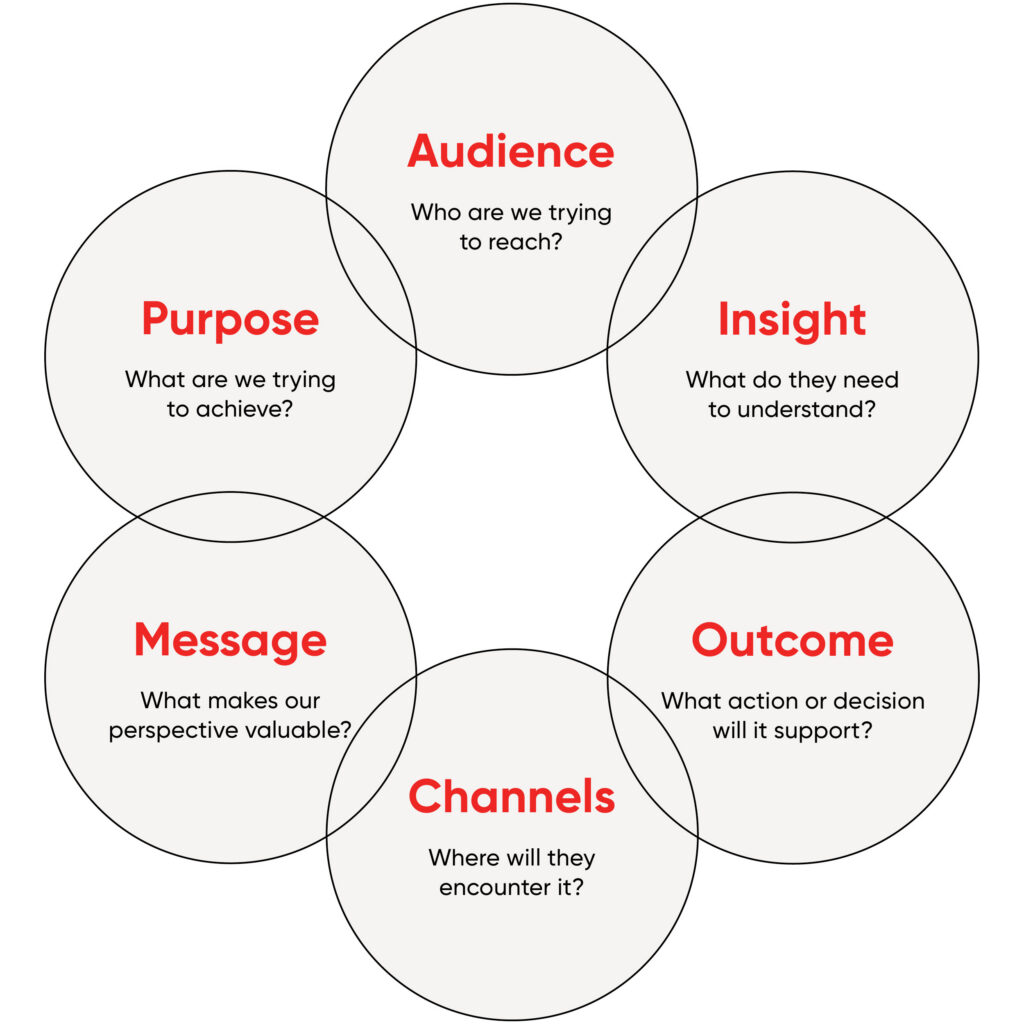
An effective content strategy can start with a straightforward conversation:
- What do we want our business to accomplish?
- Who are we trying to reach?
- What questions are those people asking?
- What makes our approach meaningful to them?
- Where do they look for information?
- What would help them take the next step?
The answers provide a foundation for content that is useful to the audience and valuable to the business because the real purpose of content is not simply to say something. It is to give the right people a reason to listen, a clearer understanding of your value and the confidence to move forward.

About the Author
Michael E. Ozan, Co-Founder & CEO at TWIST Creative, is a strategist and brand builder trusted by purpose-driven CEOs and boards. For over 25 years he’s delivered market guidance and campaigns that align teams, sharpen spend, and produce measurable, defensible outcomes.
